20101205

Cybernenic Art

When Norbert Wiener coined the term Cybernetics, I tend to doubt he had Cybernetic Art as the foremost reason for coining the term. While I believe while Mr. Weiner had a very large vision of cybernetics as the basis or foundation of controlling systems through feedback, I doubt he envisioned the artistic results that resulted from an artist’s concept of interaction and promotion with a work of art. Nicolas Shöffer, Les Levine and Ken Rinaldo are probably some of the more famous artists to utilize the concept of cybernetics, interaction and feedback in works of art. In my opinion, one of the most interesting pieces I have found was created by an artist, originally from China, Wen-Ying Tsai, who was influenced heavily in mechanical engineering, painting and sculpture in the United States.
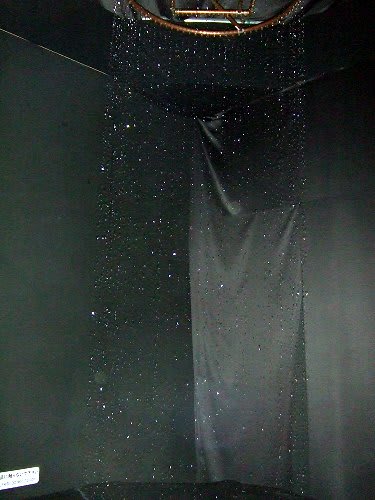
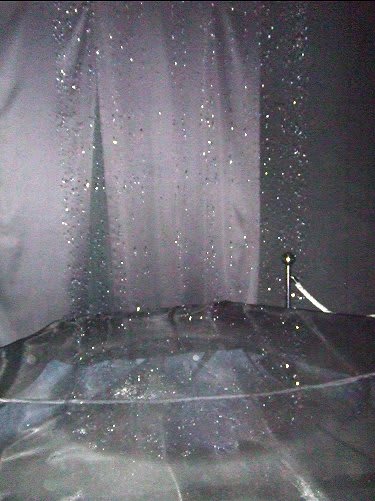
            In 1991 displayed his cybernetic sculpture “Desert Spring” and won the ARTEC Grandprix. The piece takes some elements for his earlier work and focuses more on a self-regulating relationship of the sculpture and its environment. In concept, it appears similar to the concepts of Ken Rinaldo’s “Autopoesis,” “Desert spring” was created and displayed almost a decade before Ken Rinaldo’s piece. When a viewer enters the display space, “Desert Spring” senses the disruption of its normal tranquil state through infra red and audio sensors and begins to “destabilize from normal relaxed undulations to excited rapid palpatations.” The work appears to focus on natural behavior versus disturbed or disrupted behavior. The piece only returns to its tranquil state when the observer or observers leave the space.
            Personally, I find the concept of the work to be almost a base of “Autopoesis,” while being more pleasing in appearance at the same time. Granted, it is probably not as technically intricate and complex, but I like the display and installation being in a darkened room with the brilliance of the sculptures color accented by light; I believe it makes one focus on the piece rather than being overwhelmed by the view of multitudes of robotic arms hanging from the ceiling in a stark white room. I believe the main focus on interaction or feedback of sensing the watchers presence and the works’ disruption from normal behavior or stasis to be pretty much the same.


Generative Art

            Brian Eno is probably one of the best known Generative artists of our time; many may not know his name, but have probably heard some of his music, whether designed, performed or produced. Brian Eno was approached by Microsoft in 1994 to compose music for the Windows 95 project. The six-second long Windows start-up “tune” was the result of his work. In recent years, Mr. Eno has collaborated with other and performed and produced with musical products and he is often referred to as the creator or father of ambient music. Brian Eno partnered with Peter Chilvers and produced the iPhone application “Bloom” as a result.
            Bloom is an application that appears to have generative properties in that there appears to be parameters established for a range of notes and tones that can be created and played by an individual touching the iPhone screen. I do not have an iPhone and cannot try this application out for myself, or give a full review of the capabilities for the application. I can say that various clips that can be found on YouTube, and I found the concept to be interesting, to say the least. Bloom appears to have two basic modes to use: “Listen” and “Create.” I’m assuming the “Listen” mode generates some type of randomized music that might remind one of wind chimes on a synthesized piano, and that the music shouldn’t be identical to any music previously heard through the application. The “Create” mode appears to replicate a user’s touch of the iPhone screen to notes that are played, repeated several times as the note or series of notes fades away, and accompanied by some colorful graphic displays of various colors appearing and fading at the points the screen was touched.
            If I had an iPhone, this might be one of the few applications I would try and acquire. In the “Create” mode, I doubt anyone could accurately duplicate a tune or melody; each note produced by a touch might only be a few pixels of separation, if not only one pixel per note. It would appear that no matter how hard one tried, short of actually recording a creation, an exact replication could not be reproduced. In a world where some have said all the great music has already been written, Bloom could stand as a beginning to widespread personal access to a simple and easy to use generative music creator.
           

20101204

Algorithmic Art

One of the first computational art concepts we were presented was the concept of Algorithmic Art. Almost immediately, at least to my mind, computer graphics the might remind a person of a Spirograph image might come to mind. Algorithmic art is essentially art that is generated by some type of automated process. The concept of Algorithmic Art often focuses more on the process or rules given and followed to create an artistic piece.
            Vlatco Ceric is an example of an algorithmic artist that creates not only graphics, but sculptures as well. On Mr. Ceric’s website, one can see part of the process, and final installations, of at least two of his sculpture pieces. Matrix is my favorite example of algorithmic sculpture, primarily due to the “final installation” image. The work, to me suggests a strange dichotomy between not only an algorithm and nature, but between man and nature.
            The final installation of Matrix, to me, shows man seems insignificance in relation to the vastness and complexity of nature. Matrix, by itself, reminds me of a city created by man. The city appears complex when it is focused on. However, when a city is contemplated in a greater sense with the world surrounding it, a city seems regular and perhaps simple. The pieces of wood used to create the piece appear to only be of two sizes, arranged in an algorithmic pattern, but the wood and its grain also suggest that not all pieces are identical. When the final product is installed within view of a forest it shows where man’s civilization has come from and, perhaps, it is not an improvement from where we came. Below is an image the final installation of Matrix, 2006, by Vlatko Ceric.


20101203

Introduction

I decided to switch my college major from Computer Science (C Sc) to an Information Science, Technology and Arts (ISTA) Bachelor of Arts (BA) degree in the summer of 2010. I was a bit disillusioned at my ability, or lack thereof, in the Computer Science courses, and was very interested when the recently established School of Information Science, Technology and Art (SISTA) announced it would be offering both BA and Bachelor of Science (BS) degrees. I had been with computers and applications related to my former employment in the military and civilian realms for quite a few years, and I was intrigued by the concept of how information was processed, disseminated and retrieved for quite some time. One of the things that keyed me off as this program being different was the addition of to last word of SISTA and ISTA, Arts. In my youth, I also had an interest in Theatre Arts (which, by the way, is my minor). As far back as I can recall, science and art had always seemed to be mutually exclusive. One might use a computer to generate a piece of art, but as I have come to learn that information, science and art may not always be enmeshed, they are not exclusive of each other.
I ended up taking just about every ISTA course available the fall semester, but one proved to be one of my favorites at the University of Arizona (UA); ISTA 301, Computing and the Arts. I expected the course to be focused on how computers influenced or generated art, but came to learn much more. Yes, there was a bit about computers and computer art, but the class ended up being more about the “concepts” of computing and how they have influenced art. There was also quite a bit of presentation and discussion on the idea and perception of “art” itself.
When people think of the definition of art, many things may come to mind: paintings, sculpture, photography, theatre, music, dance, literature, and perhaps other forms or sub-forms. Some common thoughts are that art has an aesthetic quality, or it conveys the emotions of the artist at the time the artist creates a piece. Another common opinion is that art is a highly subjective idea, and I believe it is. In my opinion, Leo Tolstoy communicated the greatest concept of art when he suggested that “art lifts man from his personal life into the universal life.” To me, this suggests that while art can be a very personal thing, subjective, it ties all man together through some universal thread, objective. This notion also implies that art is a thread common to all peoples that is not merely aesthetic, although it often possesses this quality, but it conveys and ties all man together through emotions, intellect and perhaps some spiritual medium. To my knowledge, no other being possesses the ability to create and appreciate art in its many forms, except perhaps God. Animals have been said to “create art”, but I believe this is not the case, as other animals receive nothing intrinsic from a piece created by another animal, even of the same species. Though each of us may have subjective thoughts on what is or is not art, but generally, we agree that on some level true art expresses some feeling or thought to another human being, and that fact shows man’s art joins all mankind together to varying degrees.
Through this blog, I will attempt to provide further thoughts and perhaps some insight into various examples of art as it relates to the concept of “Computing and the Arts.”